This is the first in a series of articles I’ll be doing on craft behind the finished product. Interested in the science, chemistry and crafting behind brewing? Then read on! Keep in mind, I’m no brewmaster; this is simply my own knowledge and experience, so if you have something to add or comment on, please do. I’m always open to suggestions and eating your brains and gaining your knowledge … err, reading your comments and gaining your knowledge. Enjoy!
If you’re like me you’ve sat crowded around a table taking in a game at your local watering hole, or crowded around a campfire sharing laughs with friends over a round of cold refreshing beers at some point in your life. Those things just seem to go hand in hand for a lot of us. And if you’re even more like me, at some point you’ve probably taken a moment after savoring a sip of that liquid gold to think “is this the result of some magic conjured by forces of some Gandalf-esque wizard?” And if you have indeed asked that question … well, you’ve probably had a few too many. But the fact that you’ve pondered how that frosty brew came to be is what matters, and the amount of work that gets put into your favorite bottle or pint will likely surprise you. It certainly did me, as I recently decided that I wanted to make an attempt at brewing my own beer from scratch. And down the rabbit hole I ventured …
After deciding that I wanted to try a home brew, my initial thought was “how hard can it be?”; that is somewhat of a loaded question when it comes to this topic. Think beer is just yeast, barley, hops and water? While you are half correct in that thinking, there is a complete science that comes along with it, science that, if ignored, can yield a simply mediocre brew, or even a spoiled batch. As I began to do my research on different styles, ingredients, equipment, etc., I realized that this process was something I should probably take my time with. Having the proper water is something that can alter the flavor of beer in ways you probably wouldn’t expect. Things such as magnesium, bicarbonate and chloride can contribute in positive and negative ways when interacting with the ingredients in your beer. Confused yet? Good. Too drunk to care? Cheers.
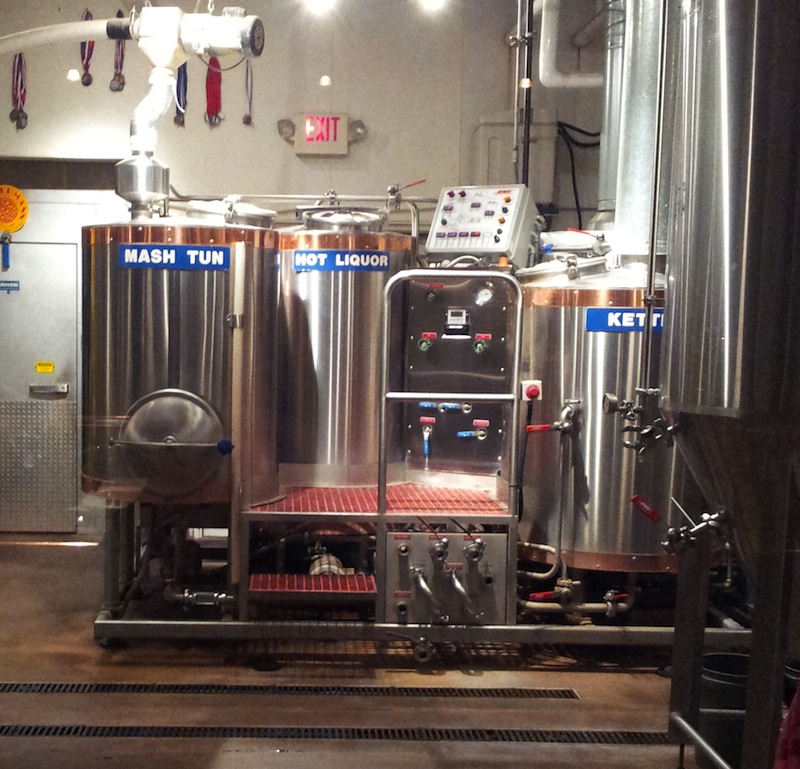
The science behind beer is, at least for a nerd such as myself, quite an interesting subject. However, even if the chemistry lessons that brewing will provide you won’t get your gears turning, getting to fine-tune your recipes with different ingredients should do the trick. You’re an IPA fan, you say? Well, let’s start adding those hops! But you’ll want to make sure and try different varieties and amounts, and at different intervals during your boils (I’ll explain the “boils” another time; I’m trying to be concise). Or are you a lover of dark beers like myself? Then have some fun with different types of malts! Get ambitious and fashion a dunkelweizen of your own creation! Therein lies the fun of brewing your own beer: once you learn the how-to, the possibilities of creation are limited only by your own imagination. (A chocolate cherry stout? Yes, I think I’ll try that)
But back to the heart of this diatribe … if you do a little research, you’ll find a wealth of hard work has gone into every drop of what you are now sipping. It’s something that is vastly overlooked by even the most devout brewheads. But the next time you are in the Tractor Taproom in Nob Hill, or downtown at Marble, or at any of the other delicious microbreweries we are fortunate enough to have in our city, remember all the hard work and brain power that has gone into your beer. Because once you dig your nose deep enough into it, you’ll see that a beer is not simply beer; it is a work of art and science merged together in a cold, refreshing concoction. Raise a glass to your brewmasters when you see them. And wish me luck on my own home brewing adventure. I will be keeping my progress updated here on our page.
Prost!
— Brandon “Barleygrinder” Daniel
 DARK SIDE BREW CREW